In introductory calls, the same questions come up almost every time. Is a symbolic ceremony legally valid in Switzerland? How many songs belong in the ceremony? What does it all cost? ...
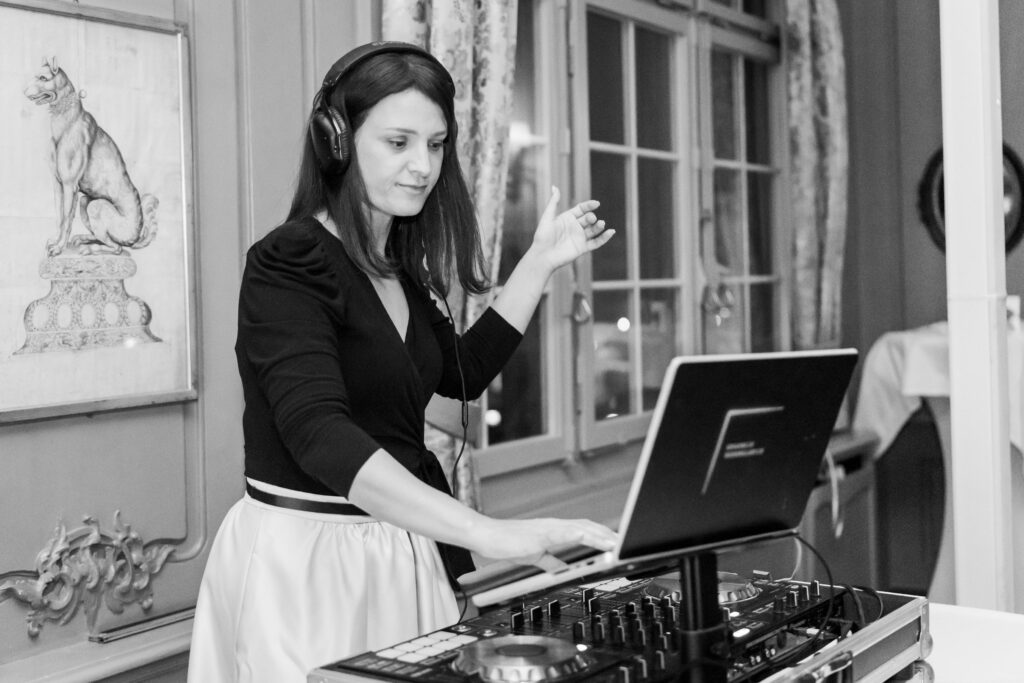
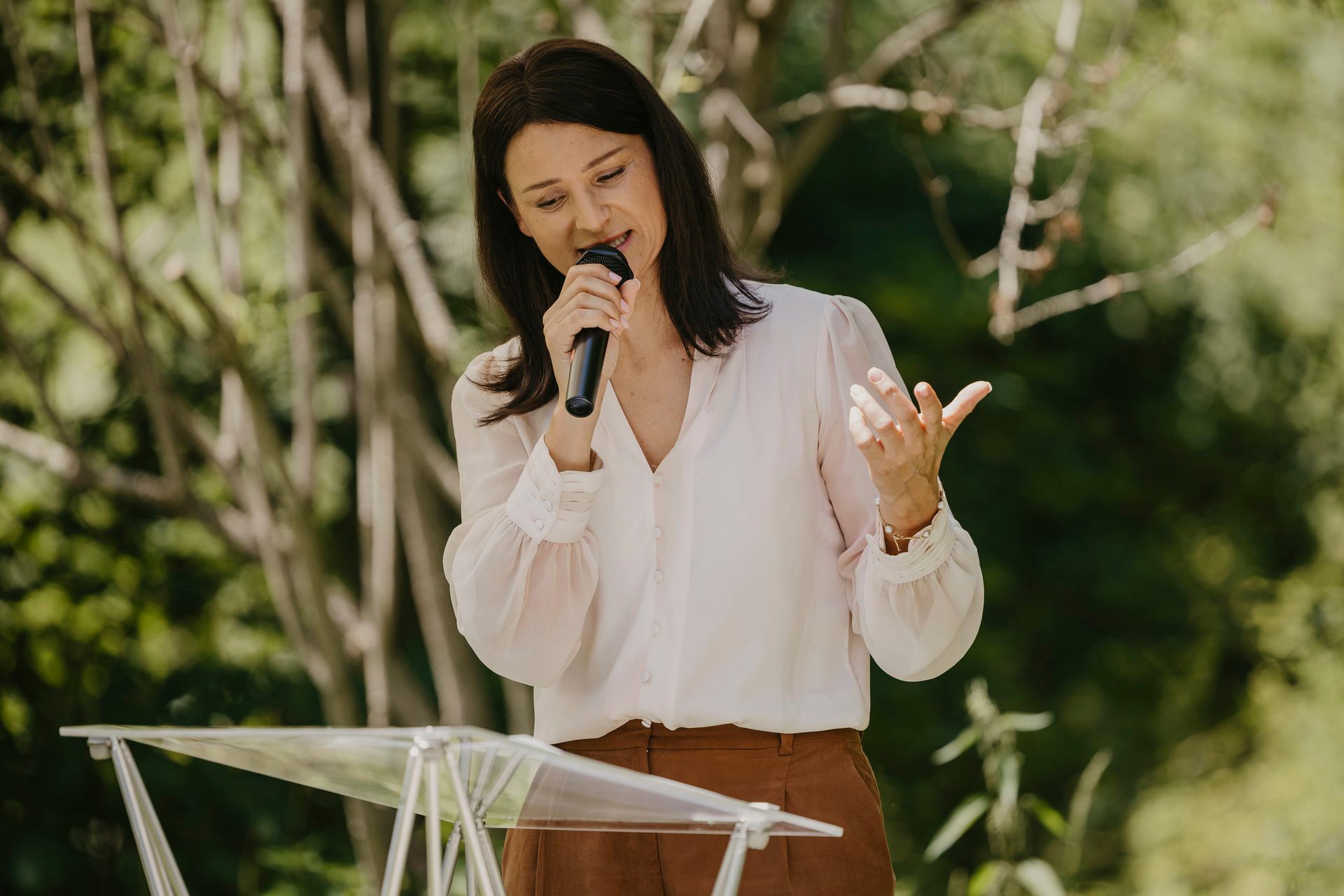
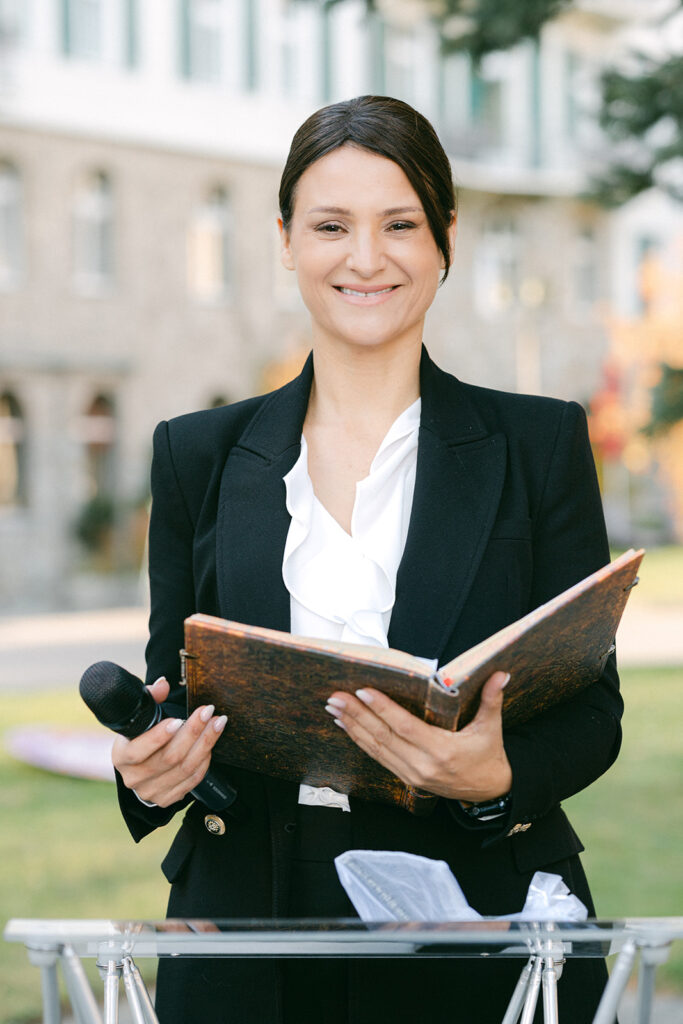
I’m Naomi Ben, wedding celebrant, wedding singer and DJ. Since 2018 I have accompanied weddings in Zurich, across Switzerland and abroad – more than 300 weddings and events by now. Because I take on the ceremony, live singing and DJ set myself, I see a wedding day from the entrance to the last song – and the answers in this article are written from exactly that perspective.
The FAQ is organised by topic: from the basics of a symbolic ceremony in Switzerland to booking, the ceremony and music, through to the party and costs. Each question starts with a short answer, followed by background and experience from my everyday work.
Want to find out straight away whether we’re a good fit? Then get in touch via the contact page for a free, no-obligation introductory call.
Symbolic ceremonies in Switzerland: the basics
What is a symbolic ceremony?
A symbolic ceremony is a wedding ceremony without religious or official requirements, tailored entirely to the couple and placing their story at the centre.
Unlike in a church or at the civil registry office, there is no fixed order you have to follow. You decide which words are spoken, whether there are rituals, which music is played and whether family or friends contribute. The location is your choice too.
In practice, this doesn’t mean a symbolic ceremony becomes arbitrary. Precisely because no liturgy sets the framework, it needs a clear structure: a beginning that welcomes the guests, a middle part in which your story is told, and moments when it goes quiet. Holding this framework is the real task of the wedding celebrant.
I describe why more and more couples choose this form in the article The Meaning of a Symbolic Ceremony.
Is a symbolic ceremony legally valid in Switzerland?
No, a symbolic ceremony has no legal effect in Switzerland. Marriage is concluded exclusively at the civil registry office; the symbolic ceremony takes place in addition.
If you want to be legally married, there’s no way around the civil registry office. Many couples deliberately keep this appointment small, sometimes even without guests, and then celebrate the big, personal ceremony with a symbolic ceremony. That way you have both: legal certainty and a ceremony that sounds like you.
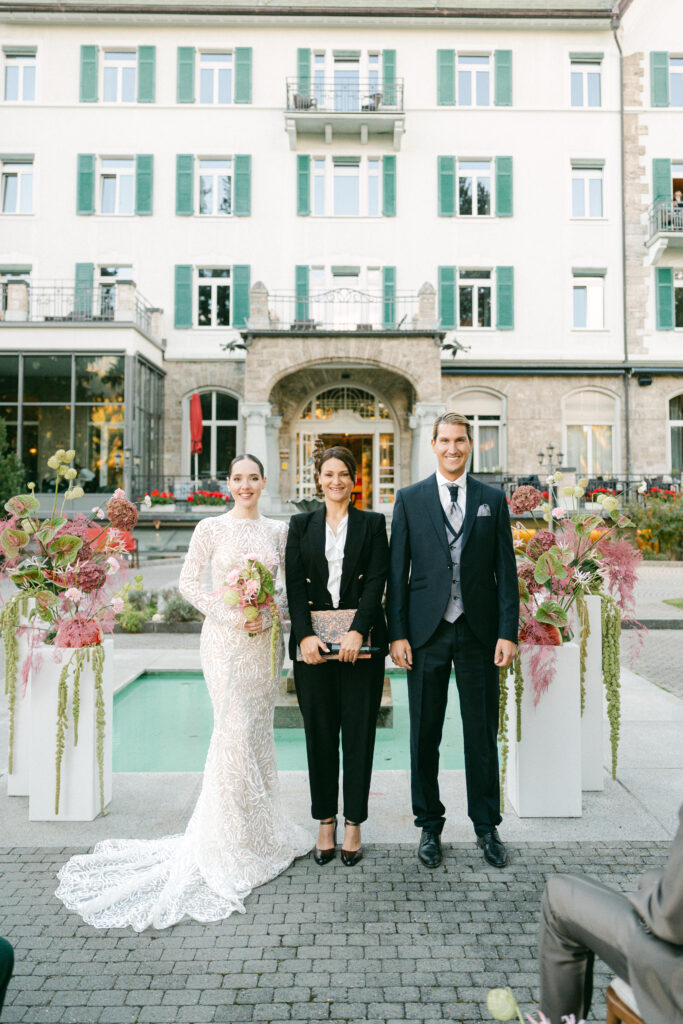
There are also places where both can be combined well. The Dolder Grand in Zurich, for example, is an official wedding venue of the City of Zurich; according to the hotel, civil ceremonies take place there on selected dates in the historic libraries.
You can read more about the legal aspects in the article Wedding Celebrant Switzerland: What to Look Out for When Booking.
What is part of a symbolic ceremony?
Typical elements of a symbolic ceremony are welcoming the guests, a personal ceremony speech, music, symbolic rituals, vows and the ring exchange. You decide which of these you include.
None of these elements is mandatory. Some couples write their own vows, others prefer to listen. Some want a ritual, others feel their story carries enough on its own. What matters is that every element has a reason and isn’t included just because “that’s how it’s done”.
My preparation includes a personal introductory meeting, a schedule with a common thread, writing the speech, coordinating with suppliers such as sound and music, and leading the ceremony on your wedding day. You can see what this means in detail on the page Wedding Celebrant with Live Singing.
Where can a symbolic ceremony take place in Switzerland?
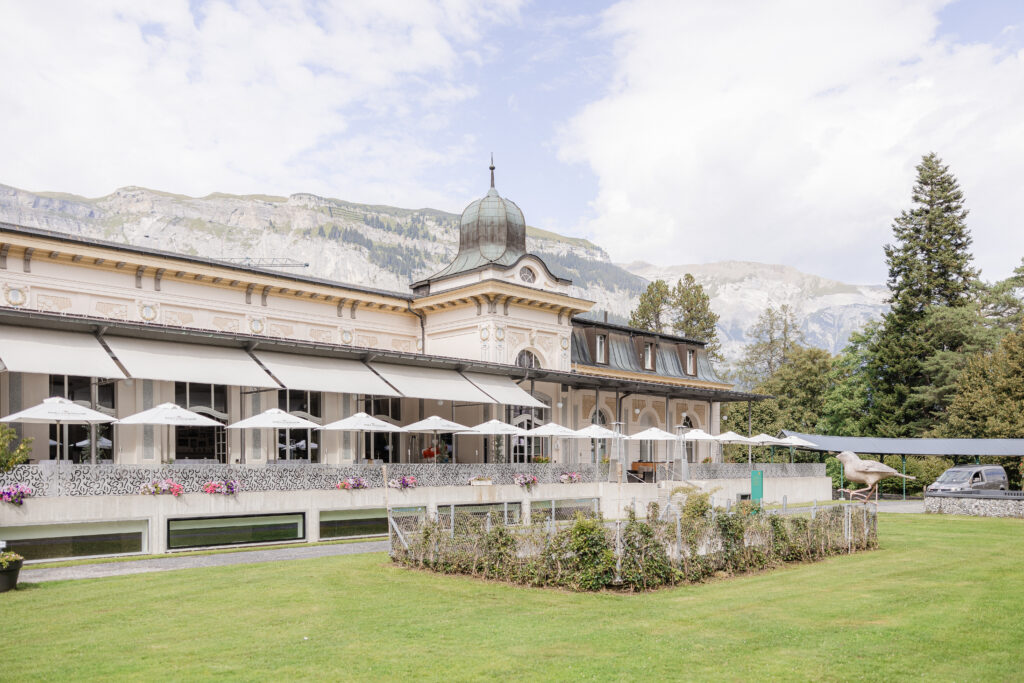
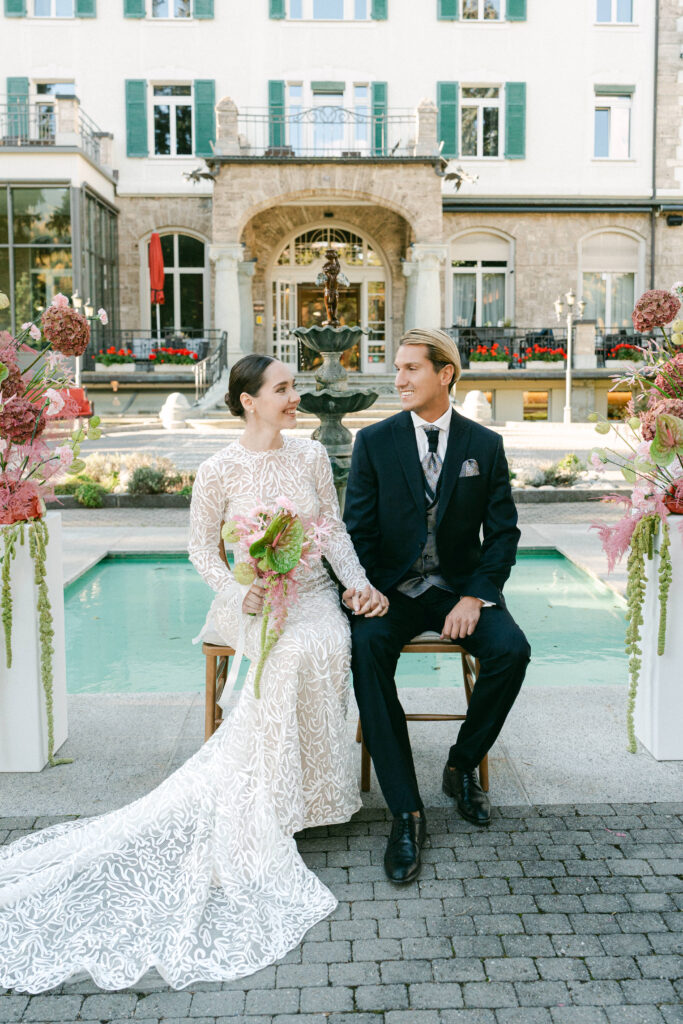
In Switzerland, a symbolic ceremony can take place almost anywhere: by a lake, in the mountains, in a forest, in a castle, in a luxury hotel or on a farm. What matters is that the place suits you and offers a good bad-weather option.
After more than 300 weddings and events, I’ve experienced many venues and learned one thing: it isn’t the most expensive venue that makes the day, but the one where you feel at home. Some of my most emotional ceremonies took place at venues far less well known than the big hotels.
My advice: visit your favourite venue in person instead of just looking at pictures. Pay attention to how the ceremony sounds in the room, how the light falls at the time of the ceremony and how far it is between ceremony, drinks reception, dinner and party. Details like these later decide how your day flows.
You’ll find specific recommendations, from the Dolder Grand to Hof Wiesengrund, in the article Wedding Venues in Switzerland: My Personal Recommendations from More Than 300 Weddings.
Can a symbolic ceremony take place in winter?
Yes, a symbolic ceremony works well in winter in Switzerland too – for example in a mountain hotel, a snowy Alpine landscape or a room with an open fire. A covered space for the ceremony is important.
Many couples think of summer first when planning their wedding. But a winter wedding has its own advantages: there are usually fewer weddings, so more dates are available at venues and with suppliers, and the atmosphere is often calmer and more intimate.
An example that delights me every time is The Chedi Andermatt. Its spaces range from the Wine Library for up to 35 people to combinable halls for up to 250 guests. For mountain weddings in winter, though, always plan a covered room as a fallback.
More arguments for the cold season can be found in the article Great Reasons for a Winter Wedding.
Who is Naomi Ben?
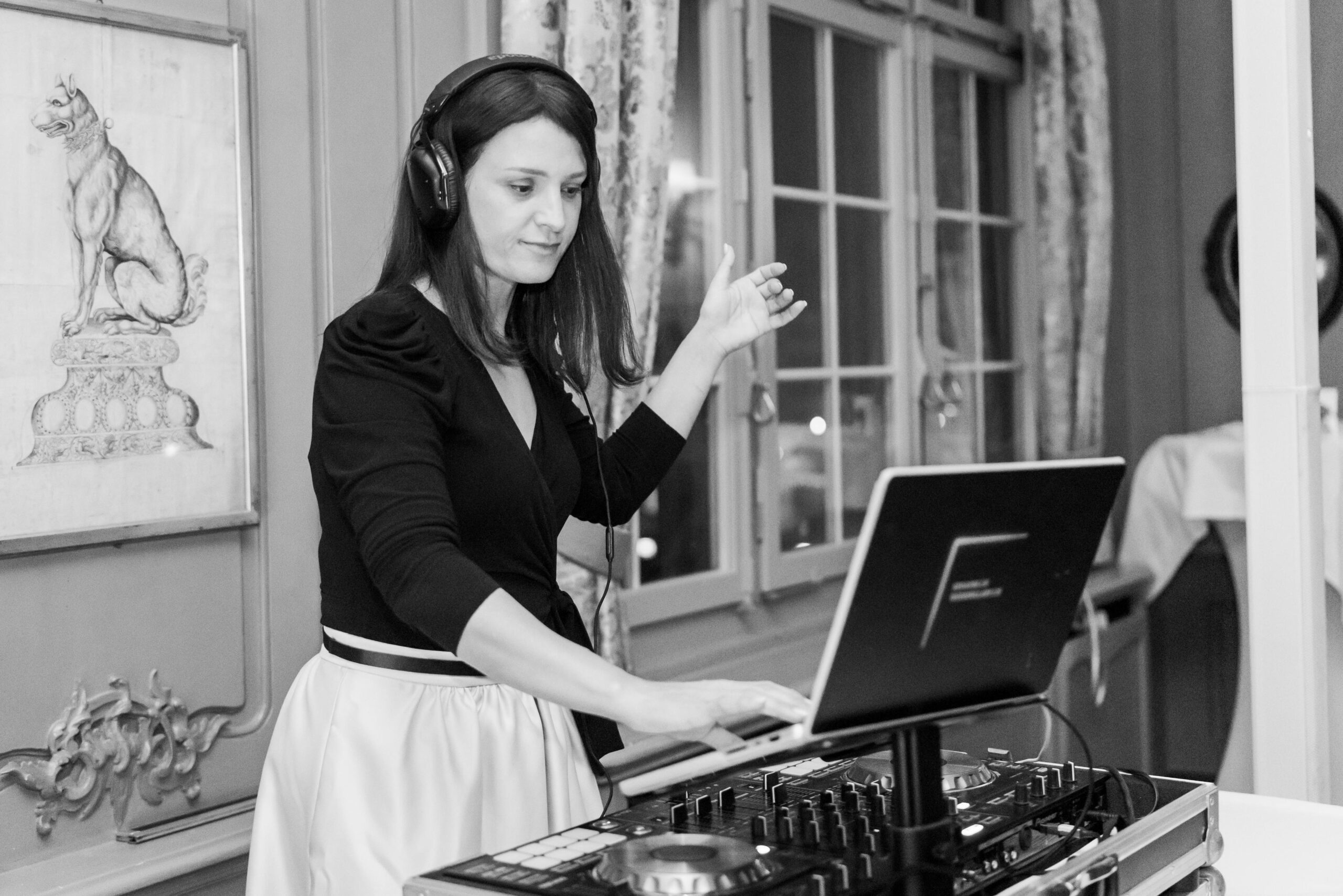
I’m Naomi Ben, wedding celebrant, wedding singer, DJ and host from the Zurich area. Since my official start in 2018, I have accompanied more than 300 weddings and events in Switzerland and abroad.
It all started with singing. As a child, nothing meant more to me than expressing emotions through music. Over the years this has grown into a concept in which ceremony, live singing and DJ set belong together. You can book me for everything together or just for the one highlight you’re still missing.
I have performed at venues including the Dolder Grand, the Bürgenstock Resort, Villa Honegg and the Kempinski Palace Engelberg, and abroad in places such as Santorini and Khao Lak. Besides weddings, I accompany corporate events as an Event DJ and Live Singer, and in my Academy I train wedding celebrants.
You can read more about my journey and my references on the page About me.
What is the Full Wedding Package?
The Full Wedding Package combines symbolic ceremony, live singing and DJ in one hand. The complete package with symbolic ceremony, live singing and DJ starts from CHF 2,990.
The idea behind it: instead of coordinating three suppliers who barely know each other, you have one person with one style who thinks your day through from the first word to the last song. There are no handovers between celebrant, singer and DJ, because I take on all three roles myself.
The package is put together individually and depends on the scope, location and duration of your wedding. So you don’t pay for services you don’t need. All elements can also be booked individually.
You’ll find an overview of the concept on my homepage.
Finding and booking your wedding celebrant
What should we look for when choosing a wedding celebrant?
Above all, pay attention to personal chemistry, to experience in leading ceremonies, and to whether the speech is written for you rather than pieced together from templates.
The wedding celebrant tells your most personal stories in front of your most important people. That only works if you trust them. So take the introductory call seriously and pay attention to whether you feel understood.
Also ask specifically about the preparation process: How many conversations are planned? When will you receive a draft? Are changes possible? Clarify which services are included in the price and what is charged extra, such as travel or sound equipment.
A detailed checklist with all the points is in the article Wedding Celebrant Switzerland: What to Look Out for When Booking.
What happens after our enquiry?
After your enquiry via the form, I’ll get back to you with a rough price estimate. If that works for you, we’ll arrange a free introductory call, online or in person.
In the form, you tell me briefly about yourselves, your date, the location of your wedding and which service you’re interested in. That way I can immediately assess whether and how I can accompany you.
The introductory call isn’t about ready-made packages. We talk about your story, your ideas and the atmosphere you’d love. By the end you usually know quite quickly whether working together feels right – without sales pressure and without obligation.
You’ll find the form on the contact page.
How early should we book a wedding celebrant?
Ideally, get in touch 9 to 12 months before your wedding. Popular dates are often booked early, but short-notice enquiries are still possible depending on availability.
Weekends in high season in particular go quickly. On top of that comes the preparation: a personal speech needs conversations and time to write, and, if live singing is included, time to rehearse your favourite songs.
Booking earlier gives you more peace of mind in your wedding planning. If you’re running late, it’s still worth asking – sometimes things are possible even at short notice.
More short answers about organisation can be found on my page with frequently asked questions.
In which languages is a symbolic ceremony possible?
With me, the symbolic ceremony is possible in English, German and Swiss German, also bilingually. This applies to the speech, the conversations and the music.
This is a big advantage, especially for international or bilingual weddings. If some of your guests don’t understand German, the ceremony can be structured so that nobody is left out – either with translated passages or fully bilingual.
It’s best to clarify the language in the introductory call. It affects not only the speech but also the song choice for the entrance, ceremony and recessional.
I describe how I structure ceremonies on the page Wedding Celebrant with Live Singing.
Do you also do destination weddings?
Yes, I accompany weddings in Switzerland and worldwide – most often in Italy, Greece, Mallorca and the USA. I also accompany international couples who marry in Switzerland in English.
Many couples deliberately come to Switzerland from abroad – for the landscape, the calm and the quality. For them it’s a relief when ceremony, live singing and DJ come from one hand and communication runs in English.
For weddings with a longer journey, travel and, if needed, an overnight stay are discussed transparently in advance. Planning works well from a distance too, from the first video call to the wedding day.
For international couples, I wrote the English article Destination Weddings in Switzerland .
What happens if the celebrant is unable to attend at short notice?
This should be clarified before booking: ask your celebrant what their emergency plan looks like and whether a replacement would have access to your documents and the prepared speech.
Illness on the wedding day is rare, but not impossible. Professional celebrants have a solution for this, such as a network of colleagues who can step in if needed.
Ask specifically when discussing the contract and don’t accept a vague “it’ll be fine”. A clear arrangement gives you peace of mind, whether or not you end up needing it.
The ceremony: speech, schedule and rituals
How is a personal ceremony speech created?
A personal ceremony speech grows out of conversations with the couple: about your shared story, your values and the people who play a role. With me there are no templates and no standard texts.
What I aim for in a speech: not overly sentimental, but genuine. Words in which you recognise yourselves. There can be moments to laugh, moments of recognition and moments when it goes completely quiet.
The conversations are the foundation. How did you meet? What matters to you? Which music has accompanied your relationship? From these answers I build a schedule with a common thread into which speech and music fit.
You can see how it all comes together in the videos on my page Inspirations.
How does a symbolic ceremony run on the wedding day?
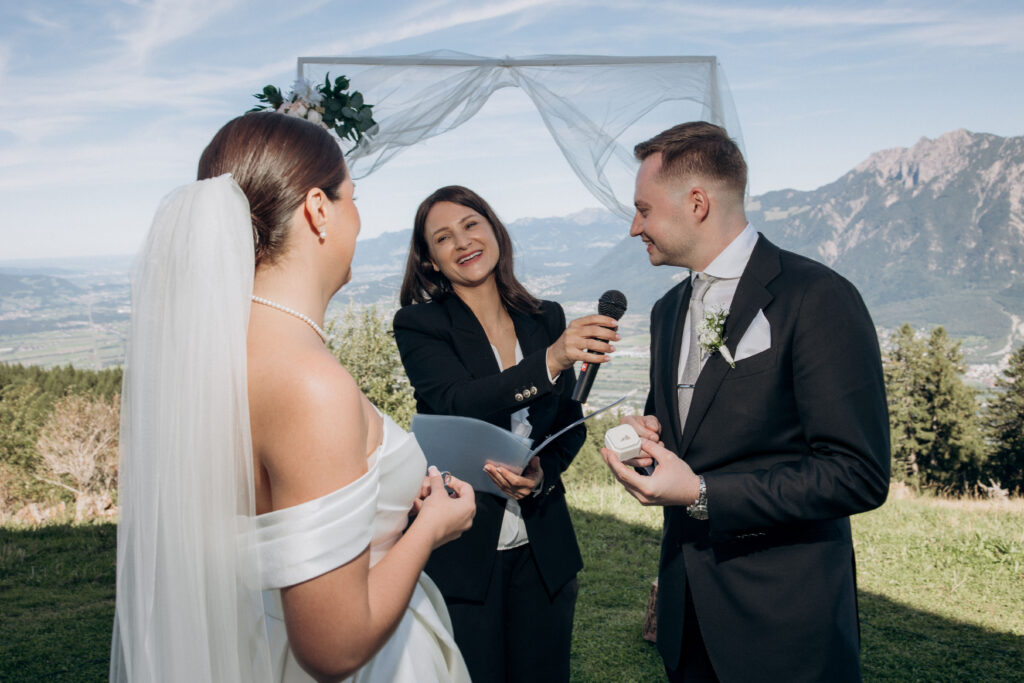
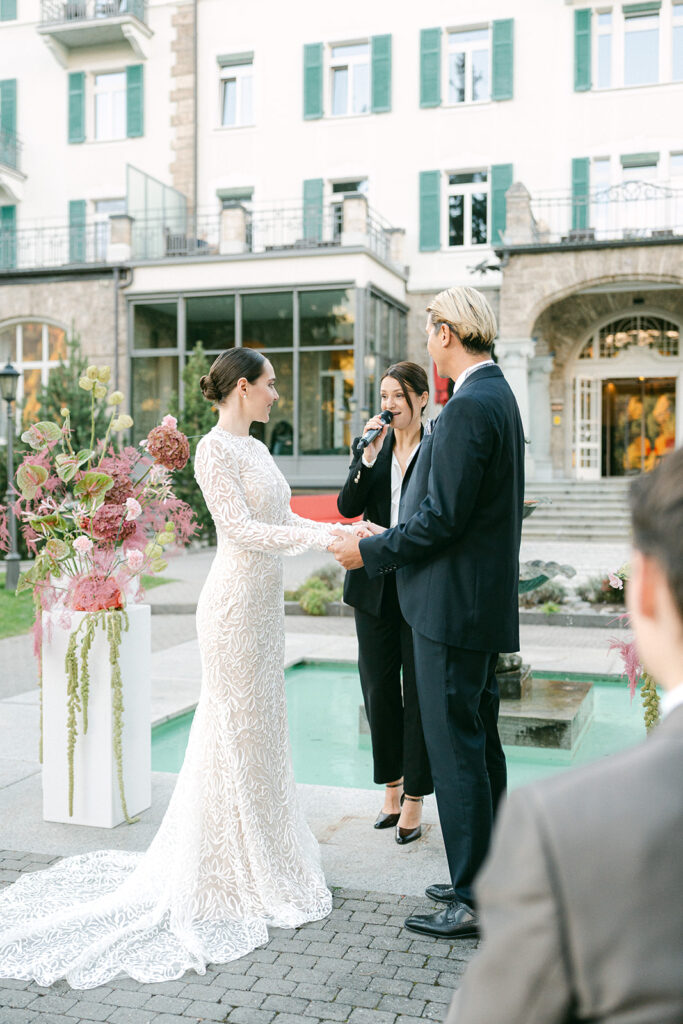
A symbolic ceremony usually begins with the entrance and the welcome, followed by the personal speech about the couple, music, rituals or vows, the ring exchange and the recessional into the drinks reception.
For you as a couple, this should feel effortless. I guide you and your guests through the ceremony from start to finish. You don’t need to memorise anything or do anything “right”.
The ceremony sets the tone for the whole day. When it is calmly and clearly guided, guests carry that mood into the drinks reception and later into the celebration. One couple wrote in a Google review: “She created an unforgettable, down-to-earth ceremony for us with lots of humour and cool surprises.” (Janine R)
I describe how a day like this feels from my perspective in the article Love Solemnly Sealed – My Life as a Wedding Celebrant in Switzerland.
Can we include our own rituals in the ceremony?
Yes, your own rituals suit a symbolic ceremony well – for example a sand ceremony, a handfasting, a wedding candle or a ritual with a special meaning for you. Family and friends can be involved too.
A ritual works when it expresses something that belongs to you. So bring your ideas to the preparation meeting. Together we’ll find the point in the ceremony where a ritual makes the most sense and whether music should accompany it.
Children can be included too. One couple wrote in a Google review: “We already had goosebumps during the entrance with ‘Speechless’, and our little son was lovingly included.” (Jennifer B)
More inspiration can be found in the article The Meaning of a Symbolic Ceremony.
Do we need a plan B for an outdoor symbolic ceremony?
Yes, for an outdoor symbolic ceremony in Switzerland you always need a plan B, because the weather can change quickly even in summer. Clarify with your venue which covered space is available in case of rain or wind.
For me, a good bad-weather option is one of the most important criteria when choosing a venue. It shouldn’t feel like an emergency solution, but have a pleasant atmosphere of its own. Look at it just as closely during your visit as the outdoor spot.
At the Park Hotel Vitznau, for example, the indoor bad-weather option features stylish rooms and remarkable art. Places like this take away the worry that a rain shower might make the moment smaller.
Also discuss how quickly a change of location is possible and plan buffers into your schedule. You’ll find more criteria for choosing a venue in the article Wedding Venues in Switzerland.
Are there volume restrictions for an outdoor ceremony?
Yes, some venues already restrict music, microphones or volume during an outdoor ceremony. You should clarify this early so that this moment isn’t unnecessarily limited.
Many people only think of the evening party when it comes to volume limits. But especially in residential areas or at outdoor celebrations, restrictions often apply during the day too, sometimes with fixed measuring points or time limits.
So ask your venue specifically: Is there a limit? How high is it? Does it already apply to the ceremony? With this information, sound and music can be planned properly from the start.
I explain what volume limits mean for the whole day in the article Wedding Party with a Volume Limit.
Live singing at a symbolic ceremony
Why live singing instead of a playlist at the ceremony?
Live singing adapts to the moment: a song can be changed in tempo, key and length and placed exactly where it has the most impact. A playlist, by contrast, always plays the original version from start to finish.
I advise couples against simply playing a song during a symbolic ceremony. Often a moment arises in which nobody really knows what’s happening: everyone sits there, the song plays all the way through, and the connection to the ceremony is lost.
Live, I can shorten a song, start it more softly or bring it in at the point where the speech is leading to it. A pop song that means a lot to you but is too fast or too loud in the original becomes a calm version that suits your ceremony.
More on this in the article Wedding Singer Switzerland: What Really Makes the Difference at Symbolic Ceremonies.
How many songs do we need for the symbolic ceremony?
Three carefully placed songs are enough for a symbolic ceremony: one for the entrance, one during the ceremony and one for the recessional. As a rule, I don’t recommend more.
Many couples get lost in long song lists. Yet music at a ceremony has more impact when it comes rarely and deliberately. Ten songs don’t make the ceremony more emotional – rather more restless.
The song during the ceremony has the greatest effect. After the vows or the ring exchange, there’s already a lot in the air. A song at exactly that point amplifies it, and live it creates a calm in the room that’s hard to achieve any other way.
If you have songs that matter to you but don’t fit into the ceremony, the drinks reception is the right moment for them.
Which song suits the entrance and which the recessional?
For the entrance, a song that draws your guests’ attention to you works well – often calm and personal. For the recessional, I deliberately recommend an energetic song so that your guests head into the drinks reception with a smile.
During the entrance, many guests are still mentally elsewhere. The right song changes the mood in the room immediately and brings everyone into the moment.
For the recessional, many couples choose something calm once more. I see it differently: this is where you set the direction for the rest of the day. A joyful song makes the transition into the reception seamless instead of feeling like an ending.
Romantic, upbeat or classic: you’ll find a selection of entrance songs in the article The Ultimate Wedding Songs.
Can I have my favourite song sung live?
Yes. If you have a song that belongs to your story, I’ll rehearse it for you, record it in advance and send you the recording so you can hear how it will sound.
That way you don’t have to wait and see – you can decide calmly whether the song feels right for you. No song is too special, as long as it means something to you: the song that was playing when you met, or one that carried you through a difficult time.
Allow some lead time for song requests, as rehearsing takes time. If a song is rehearsed especially for you, this may affect the price.
How I choose songs for ceremonies is described on the page Wedding Singer.
Do you sing with a band or solo?
I mainly perform solo, accompanied by piano or high-quality backing tracks. This makes live singing easy to fit flexibly and with little space into the ceremony, drinks reception or evening programme.
A reduced line-up has a clear advantage at the ceremony. A single voice with subtle accompaniment gives you space and doesn’t distract from what it’s really about. A large arrangement quickly shifts the focus onto the music.
It’s also simpler to organise: a solo singer needs less space and equipment than a band.
My repertoire ranges from jazz, pop and soul ballads to modern classics. You can get an impression on the page Live Singer.
What changes when the celebrant and the singer are the same person?
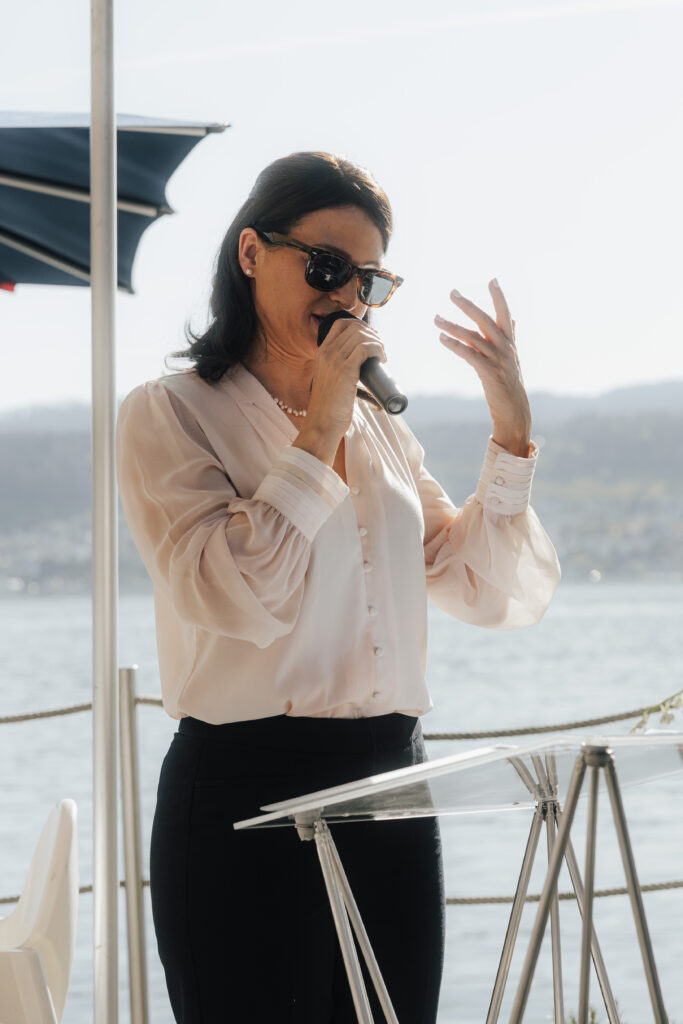
When the celebrant and the singer are the same person, speech and music flow into each other without cues or signals. You don’t need to coordinate anything, and your guests experience a moment of surprise when the celebrant suddenly starts to sing.
When celebrant and singer are booked separately, they usually meet only once before the wedding. There’s hardly any time for real rehearsals. When I speak and sing myself, I can feel directly when a moment still needs space and when music can carry it.
I especially love the moment when the guests realise I’m singing live. For example, I’m talking about your first concert together and then start singing exactly that song. Many guests tell me afterwards that this is the moment they remember most.
I explain why this makes a difference beyond the ceremony in the article Why a Celebrant, Singer and DJ from One Hand Create a Common Thread at Your Wedding.

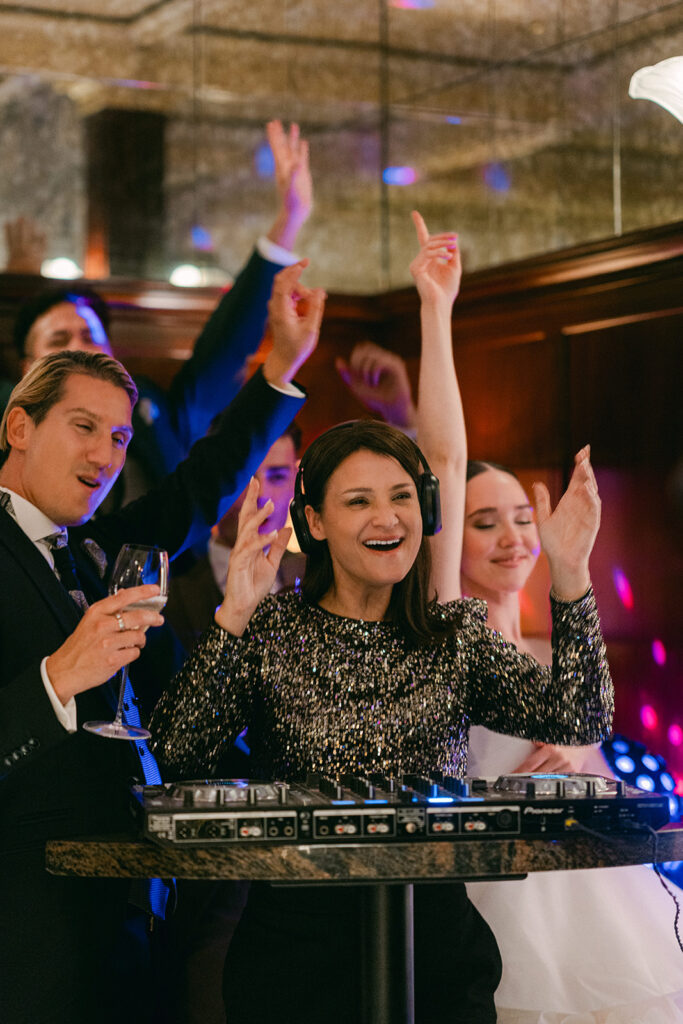
From drinks reception to party: music and DJ
Which music suits the drinks reception after the ceremony?
Calm, stylish live music suits the drinks reception – for example jazz or pop in a reduced form. Guests should be able to talk and carry the mood from the ceremony with them.
The drinks reception isn’t about a show. The music is there without pushing itself forward and gives the reception a frame while guests arrive, raise a glass and congratulate you.
This is also the place for songs that matter to you but didn’t fit into the ceremony. On request, live singing can continue through dinner and later flow into the DJ set.
I describe how I use live singing throughout the day on the page Wedding Singer.
Should we book a DJ or live music for the party?
For the party, a DJ is usually the more flexible choice, because they play the original songs and can respond to the mood without breaks until the last dance. Live music shows its strengths above all during the ceremony, drinks reception and dinner.
In my view, neither is fundamentally better. A live band usually plays fixed sets and needs breaks in between. A DJ isn’t limited to a set number of rehearsed songs and can include requests more easily. Many guests also love dancing to the original versions they associate with memories.
That’s why more and more couples in Switzerland combine both: live singing for the emotional moments during the day, a DJ for the celebration in the evening. With separate suppliers, clarify early how transitions, set-up and sound are coordinated.
The pros and cons are described in detail in the article DJ or Live Music for Your Wedding – or the Combination?
What does a DJ actually do at a wedding?
A DJ shapes the music of the evening, reads the mood on the dance floor, creates highlights, includes song requests and takes care of sound and volume. Playing a playlist is only a small part of it.
In advance, I clarify the schedule, time slots and musical direction with you. On the night itself, I stay flexible and react to the guests. The result isn’t a random mix, but an evening that builds.
Musically, a lot is possible: current charts, 80s and 90s, house, pop, rock, international hits and Swiss classics. This range is especially important at weddings with several generations. One couple wrote after their wedding: “Her music choice as a DJ was simply brilliant and made sure the dance floor was full all evening.” (Christina E)
The article What Does a DJ Do at a Wedding? describes the many roles with a wink; you’ll find more about my services on the page Wedding DJ.
How does a wedding DJ get guests onto the dance floor?
A good wedding DJ constantly watches how guests react and chooses the next song based on that. The most important question isn’t “What do I play next?” but “What does this room need right now?”
While I’m DJing, I watch for small signs: Who is already moving along? Who looks straight at their friends during the intro? Who puts down their glass and heads for the dance floor? You can often see a song reaching a room long before anyone dances.
Time and again I see that a 20-year-old song has more impact than a current hit with millions of streams. Older songs are linked to a piece of their own lives for many guests. That’s why a good music selection never works through the charts alone.
I explain what psychology and the brain have to do with it in the article How a Professional Wedding DJ Influences the Mood of Your Wedding.
Is the party worse if the venue has a volume limit?
No, a wedding party with a volume limit can work just as well. What matters is knowing about the limit early. In Switzerland, according to the federal ordinance (V-NISSG), the hourly level at events with amplified music may not exceed 100 dB(A), and additional requirements already apply from 93 dB(A). Many venues also have their own, lower limits.
Volume and party atmosphere are not the same thing. When I have to work with a lower level, I become more precise: every song has to land, every transition has to be right. I then think in waves rather than at maximum, set targeted highlights and use surprising changes of style when the energy dips.
The most common mistake happens earlier: couples fall in love with a venue and only learn about the limit after booking. So before signing the contract, ask how high the limit is, where it is measured and what happens if it is exceeded.
All the questions you should ask your venue are in the article Wedding Party with a Volume Limit.
What equipment do you bring for the party?
I always work with my own professional sound and lighting equipment. That gives me full control over sound, volume and atmosphere, indoors and outdoors.
With someone else’s or basic equipment, I lack control over how the sound is distributed. With my own system, I know exactly how to react – for example when a decibel meter gets critical. The position of the speakers is often more important than the volume itself: the sound should reach the dance floor, not the buffet.
Lighting is often underestimated. A focused, darkened room automatically creates more of a party feeling and amplifies the energy I build musically.
I coordinate equipment, power connections and set-up times with the venue in advance. You can see how I work to the same standard at corporate events on the page Event DJ.
Do you also handle announcements and programme items in the evening?
Yes, as a host I take care of announcements and transitions on request – for example the couple’s entrance, individual programme items or the cake cutting. That way every guest knows what happens next.
It’s between the programme items that an evening either feels calm and coherent or hectic. For me, hosting means structure, not self-promotion: I announce, lead over and hold the programme together so that the individual items don’t stand loosely side by side.
The arrival of the cake is a good example. With a little hosting and the right music, it becomes a moment of its own instead of an interruption. Whether you want a cake at all is discussed in the article With or Without Cake?
You can read more about my work as a host on the page Hosting.
Why do guests celebrate differently when the celebrant and the DJ are the same person?
If the DJ has already led the ceremony, she’s no longer a stranger in the evening. Guests open up faster, and the atmosphere doesn’t have to be rebuilt after the drinks reception.
A DJ who only joins in the evening works mainly with information. I’ve experienced the whole day: I know which people are close, how the families interact, who is more reserved and who lifts the mood. That’s why I often make different decisions in the evening.
Many weddings lose energy briefly after the ceremony because a new person takes over and guests have to reorient themselves. When the same voice guides you through the day, this break disappears. One couple wrote: “For the last song she even came onto the dance floor and celebrated with us.” (Lukas E)
I explain the concept behind it in the article Why a Celebrant, Singer and DJ from One Hand Create a Common Thread.
Costs and organisation
What does a symbolic ceremony with Naomi Ben cost?
The complete package with symbolic ceremony, live singing and DJ starts from CHF 2,990. If you only book DJ and live singing without the ceremony, prices start from CHF 1,890. The exact price depends on the scope, location and duration of your wedding.
After your enquiry, I’ll give you a rough price estimate, and after the introductory call a transparent quote. It shows what is included and what is listed separately, such as travel or equipment.
The price reflects not only the wedding day but also the preparation: conversations, writing the speech, rehearsing requested songs and coordinating with the venue and other suppliers.
Want to know what your wedding would cost? Then get in touch via the contact page.
How much does a wedding celebrant cost in Switzerland?
In Switzerland, a wedding celebrant usually costs between CHF 1,500 and 3,500. The price depends on the amount of preparation, the location of the wedding, the services required and the celebrant’s experience.
In the lower price range you usually get a solid ceremony with preparation and a personal speech. Those who invest more often get several in-depth conversations, more time for the dramaturgy and more intensive support on the wedding day.
So don’t compare offers by price alone, but also by content. Also remember travel costs if your venue is remote in the mountains or by a lake.
An overview of what to look out for when comparing prices can be found in the article Wedding Celebrant Switzerland: What to Look Out for When Booking.
How much do a wedding DJ and live singing cost?
With me, the DJ package starts from CHF 1,490 and DJ with live singing from CHF 1,890, each without a ceremony. With a symbolic ceremony, i.e. the complete package, prices start from CHF 2,990. A full live band is usually the most expensive option.
A band costs more because several musicians are involved and the organisational and technical effort is higher. A solo singer and a DJ are usually below that. The final price always depends on the scope, duration and services included.
How important live music is to you remains a personal decision. If you use it selectively for the ceremony, entrance or drinks reception and switch to a DJ in the evening, you get the effect of both without paying for a band all evening.
What’s included in the DJ package is described on the page Wedding DJ.
Is it cheaper to book the ceremony and singing together?
Booking the ceremony and singing from one hand not only saves coordination effort but often money too compared with two separate suppliers. On top of that, there are fewer meetings and fewer arrangements to make.
If you look for a celebrant, singer and DJ separately, you start three search processes: comparing websites, reading reviews, having introductory calls, checking availability. And in the end you tell your story three times.
If everything comes from one person, these loops disappear. Changes to the schedule don’t have to be passed on to several people, and on the wedding day you have one contact person instead of three.
You can see how the package is structured on my homepage, and the advantages in detail in the article Wedding Singer Switzerland.
Are travel and equipment included in the price?
The Full Wedding Package includes the ceremony, live singing and DJ. Equipment, travel and other details are discussed individually and clearly listed in your quote.
How high travel or equipment costs are depends a lot on your wedding: a venue in the Zurich area means a different effort than a mountain venue or a destination wedding abroad.
That’s why there’s no flat rate, but a transparent breakdown. So you know exactly what to expect before booking.
Does the celebrant need an overnight stay or a meal?
For weddings with a long journey or a late finish, an overnight stay makes sense. Whether I eat with the guests or take a short break depends on the schedule.
I’m present throughout the day and part of the celebration. What matters most to me is that your wedding runs smoothly, not where I eat. We clarify both transparently in advance, depending on the location and schedule.
If you’d like to plan your wedding in a structured way, my Wedding guidewill help you. I answer more organisational questions on the page FAQ.
Plan your symbolic ceremony in Switzerland personally
If you’re planning your symbolic ceremony in Switzerland and would like support in which ceremony, live singing and party are perfectly coordinated, I’d love to get to know you. You can book me as a wedding celebrant, singer or DJ – or for everything together.
In the free, no-obligation introductory call, we talk about your story, your schedule and the atmosphere you’d love. You’ll find the form on the contact page, and more insights on my Blog.
You can also reach me by email at weddings@naomi-ben.com or by phone on +41 76 778 12 06.